
Kinnow vs Orange vs Malta vs Mandarin: How They Differ and When They're in Season

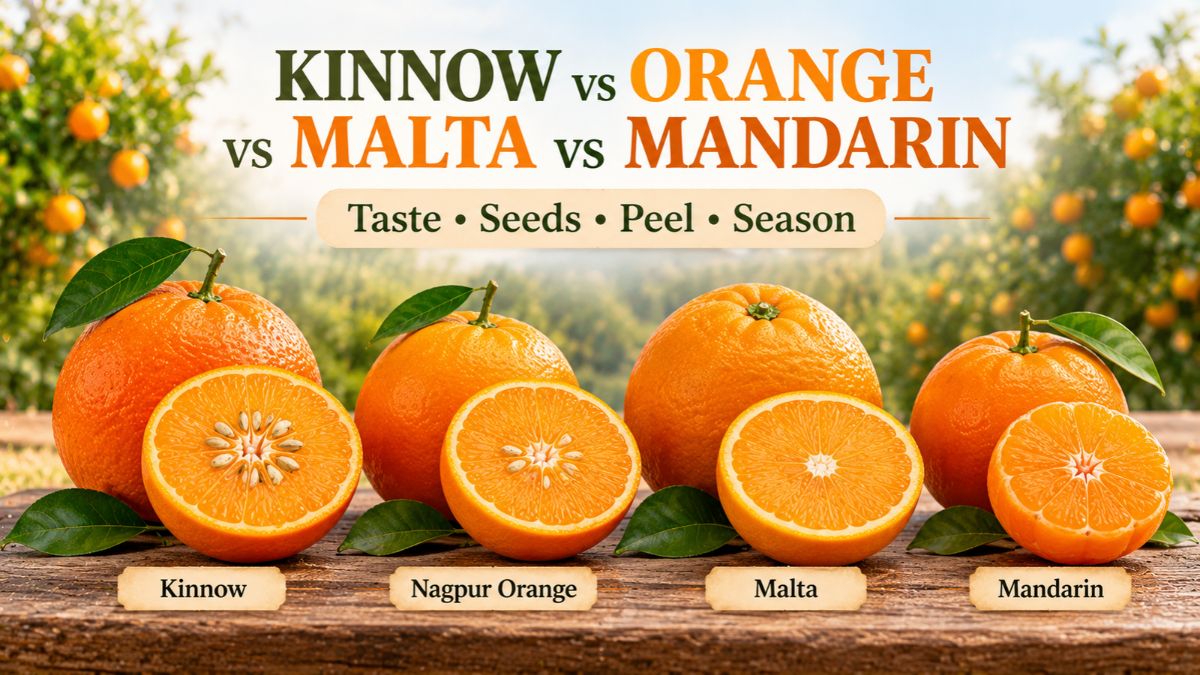
Kinnow is a mandarin hybrid grown mainly in Punjab: very juicy, full of seeds, with a peel that clings more than most mandarins. It is in season from December to February. The "orange" most Indians buy, the Nagpur orange, is also a mandarin: easy to peel, sweet-sour, and in season from October, with a second crop in February and March. Malta is a true sweet orange, grown in Punjab and Haryana, and the name is also widely used for imported navel oranges. Mandarin is the wider family that includes kinnow, Nagpur oranges and imported varieties such as Thai mandarins.
In short: for peeling and eating, pick a Nagpur orange or a mandarin. For fresh juice in winter, pick kinnow. For a seedless orange to eat in segments, pick a navel orange.
The four at a glance
|
Kinnow |
Nagpur orange |
Malta |
Mandarin (imported) |
|
|
What it is |
Mandarin hybrid |
Mandarin |
Sweet orange |
Mandarin |
|
Main source |
Punjab and nearby areas |
Vidarbha, Maharashtra |
Indian Malta from Punjab and Haryana; imported navels sold as Malta |
Imported, for example from Thailand |
|
Peel |
Glossy; peelable, but clings to the fruit |
Loose, like most mandarins |
Firmer and tighter; navels are relatively easy to peel |
Loose, like most mandarins |
|
Seeds |
Many |
Varies |
Indian Malta varies; navels are seedless |
Varies by variety |
|
Taste |
Rich, very juicy, somewhat acidic |
Sweet-sour |
Good flavour, abundant juice |
Varies by variety |
|
Best for |
Juice |
Eating |
Eating; Indian Malta also juices well |
Eating, lunch boxes |
|
Season in North India |
December to February |
October (Ambia crop); February to March (Mrig crop) |
Imported oranges: Egypt in spring and early summer, South Africa from August to October |
Depends on origin |
What is a kinnow?
Kinnow is a cross between the King tangor and the Willowleaf mandarin, developed by H. B. Frost at the University of California's citrus research centre in Riverside in 1915 and released in 1935 (UC Riverside Citrus Variety Collection). It is now grown widely in Punjab, where Abohar is the leading kinnow district and harvesting runs from December to the end of February.
The National Horticulture Board describes kinnow as a medium-sized, slightly flattened fruit with a smooth, glossy, yellowish-orange skin and firm, very juicy, somewhat acidic flesh (National Horticulture Board). Two things set it apart from other mandarins. The peel comes off, but it clings more than you expect from a mandarin. And it has a lot of seeds. Both make kinnow less convenient to eat out of hand, but they matter much less when you juice it, which makes kinnow an excellent juicing fruit.
Is a Nagpur orange an orange or a mandarin?
A mandarin. Scientists know the Nagpur orange as the Nagpur mandarin, Citrus reticulata, and it carries a Geographical Indication tag linked to the Vidarbha region of Maharashtra. It has a distinctive sweet-sour flavour. The same is true of several other "oranges" in India: the National Horticulture Board classes Khasi, Coorg and Darjeeling oranges as mandarins too.
Nagpur oranges come in two crops. The Ambia crop reaches the market in October, and the Mrig crop is sold in February and March. That puts Nagpur oranges on either side of the kinnow season. Like most mandarins, they are easy to peel and eat.
What is a Malta orange?
Malta is a sweet orange, Citrus sinensis, the same species as the oranges grown for juice around the world. In India, Malta Common is grown in Punjab and Haryana: an orange-yellow, smooth, round fruit with abundant juice and good flavour. Blood Red Malta, also from Punjab, has a scarlet blush on the skin and red-streaked flesh.
The name Malta is also used for imported navel oranges. Fruitsmith's navel oranges, for example, are listed as Navel Orange (Malta). Navels are usually seedless and relatively easy to peel, which makes them excellent for eating. They are less suited to juice you plan to keep: navel juice contains bitter compounds, including limonin, that make it taste unpleasant if it is stored, so drink it straight away (University of Arizona Cooperative Extension).
Mandarin vs orange: the simple difference
Mandarins (Citrus reticulata) are usually smaller and flatter, with loose skins that peel easily. Sweet oranges (Citrus sinensis) have a peel that sits tighter on the fruit, and they include the classic juicing oranges. Kinnow sits between the two: botanically a mandarin, but with a peel that clings, and a juicing fruit at heart.
Imported mandarins, such as Fruitsmith's Thai mandarins, are useful when Indian mandarins are out of season, and they suit lunch boxes and children.
Which is best for juice, and which for eating?
|
Use |
Best choice |
Why |
|
Fresh juice in winter |
Kinnow |
Very juicy, and the clinging peel and seeds matter less when you juice it |
|
Peeling and eating |
Nagpur orange or mandarin |
Loose skin that comes away easily |
|
Seedless segments, for children or salads |
Navel orange |
Usually seedless and easy to peel |
|
Fruit bowls and gifting |
Any, by season |
Mixed citrus looks generous on a tray, and Fruitsmith's fresh fruit gift trays can include several kinds. Penelope, for example, has navel orange, mosambi, Thai mandarin and grapefruit. |
When is each in season?
|
Months |
What is in season |
|
August to October |
Imported South African oranges |
|
October |
Nagpur oranges (Ambia crop) arrive |
|
December to February |
Kinnow from Punjab and nearby areas |
|
February to March |
Nagpur oranges (Mrig crop) |
|
Spring and early summer |
Imported Egyptian oranges |
This sequence comes from Indian trade reporting, and the exact timing shifts a little each year with the weather. Our guide to winter season fruits covers what else is at its best in the cold months, and our seasonal fruits in India guide gives the year-round picture.
How to choose and store citrus
- Choose fruit that feels heavy for its size. Weight usually means juice. The skin should be firm and glossy, without soft or sunken patches.
- Don't judge by colour alone. Colour varies between varieties, so go by weight and feel.
- Store in the fridge. Citrus keeps much longer refrigerated than in a fruit bowl. Keep it away from bananas and other tropical fruit, which ripen differently.
- Juice kinnow fresh. Kinnow juice is best the day it is made. Navel juice should be drunk straight away.
Our guide on how to store fresh fruits at home has advice for other fruit, and our guide to citrus fruits and their health benefits covers nutrition.
Frequently asked questions
1. Is kinnow an orange?
Not botanically. The main difference between kinnow and orange is that kinnow is a mandarin hybrid, a cross between the King tangor and the Willowleaf mandarin, while a true orange is a sweet orange such as Malta. It is often called an orange in everyday speech, and the National Horticulture Board lists it as "Kinnow Orange" under mandarins.
2. Why does kinnow have so many seeds?
Seediness is a characteristic of the variety: the UC Riverside citrus collection describes kinnow's seeds as numerous. That is one reason kinnow is so often juiced rather than eaten in segments.
3. Which is sweeter, kinnow or Nagpur orange?
Both balance sweetness with acidity. Kinnow is described as rich and somewhat acidic, and Nagpur oranges as sweet-sour. Sweetness depends on the batch and on how ripe the fruit is, so taste one before buying a large quantity.
4. Can I make juice from navel oranges?
Yes, but drink it straight away. Navel orange juice contains bitter compounds that make it taste unpleasant if it is kept. For juicing, kinnow and Indian Malta oranges are good choices, and any fresh citrus juice is at its best soon after squeezing.
Browse Fruitsmith's everyday fruits for citrus in season, and see our guide to types of apples in India for more on choosing winter fruit.