Types of Apples in India: Taste, Season and Which to Buy

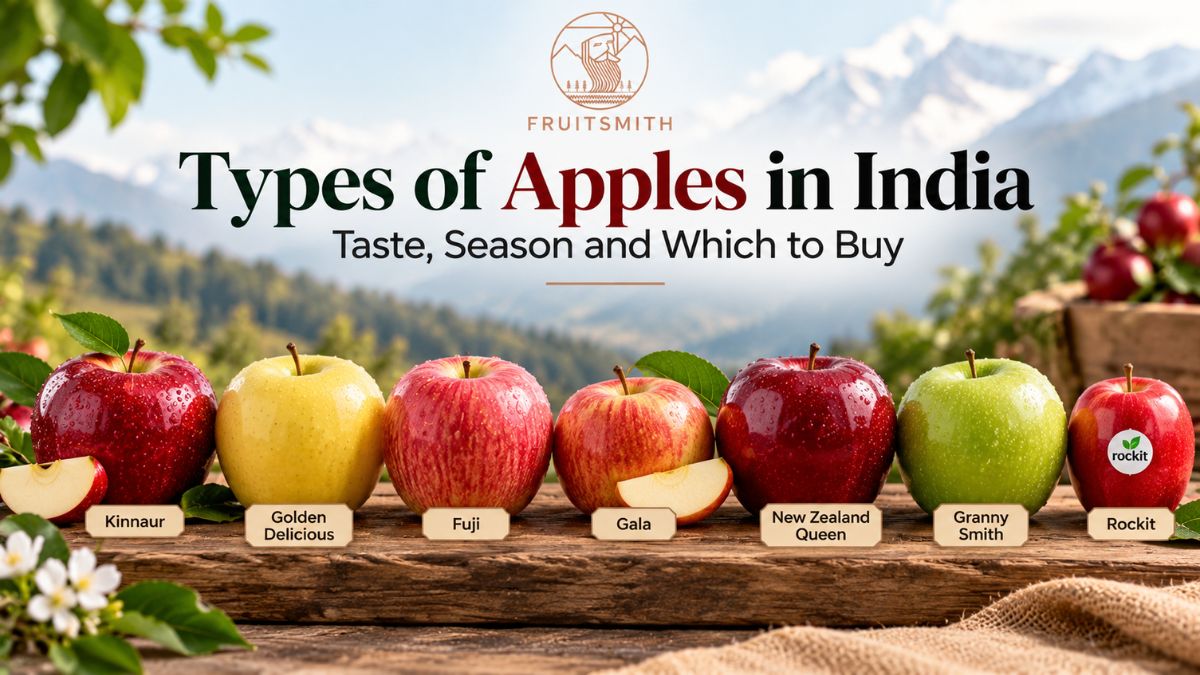
Most apples grown in India are Delicious types, led by Royal Delicious and Red Delicious from the orchards of Jammu and Kashmir, Himachal Pradesh and Uttarakhand. Golden Delicious, Kashmir's own Ambri and a growing list of newer varieties make up the rest. Indian apples are at their freshest from late August to November. For the rest of the year, and for varieties India grows little of, shops fill up with imports such as Fuji, Gala, Granny Smith and New Zealand apples like Queen and Rockit.
The differences go well beyond colour. Some apples are sweet and dense, some are tart and crunchy, some keep for weeks, and others are best eaten within days. This guide to the types of apples in India covers the main Indian and imported varieties, when each is at its best, and which to buy for what. Most of them are in Fruitsmith's everyday fruits range, and our guide to imported fruits in India covers the wider picture of fruit that comes from abroad.
Apple varieties in India at a glance
|
Variety |
Where it comes from |
Taste |
Texture |
Best for |
|
Royal Delicious and Red Delicious |
Himachal Pradesh, Jammu and Kashmir |
Mildly sweet, juicy |
Crisp, creamy white flesh |
Eating fresh in season |
|
Kinnaur apples |
High-altitude Kinnaur district, Himachal Pradesh |
Sweet |
Crunchy |
Late-season buying, October and November |
|
Golden Delicious |
Jammu and Kashmir, Himachal Pradesh |
Mildly sweet |
Firm, crisp |
Eating fresh |
|
Ambri and Lal Ambri |
Kashmir |
Ambri: a distinctive traditional flavour; Lal Ambri: mildly sweet, juicy |
Lal Ambri: crisp |
Keeping; both are known for lasting well |
|
Fuji |
Originated in Japan; imported |
Sweet, very juicy |
Firm, fine-grained |
Lunch boxes, buying a week's supply |
|
Gala |
Originated in New Zealand; imported, and now also grown in Himachal |
Mildly sweet with a hint of acidity |
Crisp but tender, thin skin |
Eating whole, salads |
|
Granny Smith |
Originated in Australia; imported |
Tangy and tart, with some sweetness |
Firm, crunchy, slow to brown |
Salads, baking, cooking |
|
New Zealand Queen |
New Zealand |
Moderately sweet, very juicy |
Crisp |
Eating fresh |
|
Rockit |
New Zealand |
Like a regular apple |
Like a regular apple, in miniature |
Snacks and children |
Indian apple varieties
Kashmir is by far the biggest apple-growing region in the country. Its orchards cover about 172,000 hectares, roughly 78 per cent of India's apple area, according to a FreshPlaza report from October 2025. Himachal Pradesh is the other major source, and its apples usually reach markets first.
Royal Delicious and Red Delicious
This is the classic red Indian apple. The National Horticulture Board describes Red Delicious as a widely planted mid-season variety: large, oblong and conical, bright to dark red and sometimes striped, with crisp, creamy white flesh and a mildly sweet, juicy taste. Royal Delicious heads the list of Himachal's main-season varieties in trade reports, and in markets, Himachal apples are often sold simply as "Shimla" apples.
Choose these when you want a familiar, gently sweet apple for the fruit bowl, and buy them between September and November, when they are freshly picked.
Kinnaur apples
Kinnaur is a place, not a variety. Apples from this high-altitude district of Himachal Pradesh include Royal, Golden, Red Delicious and Scarlet Spur, according to a National Horticulture Board brochure, which credits them with natural sweetness, good colour and a satisfying crunch. Because the orchards sit so high, Kinnaur and Spiti are among the last areas to be harvested, with picking finishing before the season closes in November.
That timing makes Kinnaur apples one of the best Indian buys in October and November, when apples from lower orchards have often been off the tree for weeks.
Golden Delicious
A late-season yellow apple grown in both Jammu and Kashmir and Himachal Pradesh. The National Horticulture Board describes it as golden yellow with prominent russet dots, with firm, crisp, creamy white flesh and a mildly sweet taste, and notes that it is used both for eating and for processing.
Ambri and Lal Ambri
Ambri is Kashmir's indigenous apple. It was once in demand well beyond the valley, prized for its taste and for a tough, leathery peel that let it keep for months outside cold storage. From the 1970s growers replaced it with higher-yielding Delicious varieties, partly because Ambri trees took many years to bear fruit, and researchers at SKUAST-Kashmir have since worked to bring it back to orchards. Ambri is also a parent of Lal Ambri, a cross with Red Delicious from Jammu and Kashmir that the National Horticulture Board describes as bright red, mildly sweet and juicy, with excellent keeping quality.
Newer names you may see
Indian orchards are changing. Trade reports on Himachal list Gala types such as Dark Baron Gala and Red Velox, and spur varieties such as Scarlet Spur, alongside Royal Delicious. Kashmir's mix includes Kulu Delicious, Maharaji and Ambri types. So Gala is no longer only an imported apple.
Imported apple varieties
Imported apples fill the gap between Indian seasons and bring varieties Indian orchards grow little of. These are the ones Fruitsmith stocks.
Fuji
Fuji was developed in Japan from two American varieties, Ralls Janet and Red Delicious, and introduced in 1962. It is a sweet, very juicy apple with firm, fine-grained flesh, and fruit specialists at the University of Massachusetts call it the best keeper of any sweet variety. If you buy a week's worth of apples at once, Fuji is the safest choice. Fruitsmith's Fuji apples come from the USA.
Gala
Gala was raised by J. H. Kidd in New Zealand around 1934, from Kidd's Orange Red and Golden Delicious (NSW Department of Primary Industries). It is mildly sweet with a hint of acidity, with flesh that is crisp but tender. The thin skin bruises easily, and Gala keeps only about a week at room temperature, so buy it in smaller amounts and refrigerate it. Its tender bite makes Gala apples easy to eat whole, skin and all.
Granny Smith
The bright green apple began as a chance seedling in a backyard in Eastwood, New South Wales, before 1868. It is tangy and tart with some underlying sweetness, firm and crunchy, and slow to turn brown once cut, which makes it good for salads. It also holds its shape when cooked, so it is a good choice for baking. Buy Granny Smith apples, and read about the benefits of green apples if you are choosing them for nutrition.
New Zealand Queen and Rose
New Zealand Queen is a cross of Gala and Splendour from Hawke's Bay, one of New Zealand's main apple-growing regions. It has deep red-crimson skin and crisp, very juicy flesh, and it is sweet without being sugary. Fruitsmith stocks New Zealand Queen apples as well as Rose apples from New Zealand.
Rockit
Rockit is a miniature apple from New Zealand, only slightly bigger than a golf ball. It was developed by the country's Plant and Food Research institute, and apart from its size it looks and tastes like a regular apple. Sold by the piece in small packs, Rockit apples fit lunch boxes and children's hands better than a full-size apple.
Fuji vs Gala: which should you buy?
These two red imports are easy to confuse, but they eat quite differently.
|
Fuji |
Gala |
|
|
Taste |
Sweet and very juicy |
Mildly sweet with a hint of acidity |
|
Texture |
Firm and fine-grained |
Crisp but tender; thin skin that bruises easily |
|
Keeps |
A long time in the fridge |
About a week at room temperature |
|
Choose it for |
Buying in bulk, lunch boxes, sweeter taste |
Eating within a few days, salads, a lighter bite |
When are apples in season in India?
|
Months |
What is freshest |
|
July and August |
Himachal's early varieties, then the start of its main harvest |
|
September to November |
Peak Indian season: Himachal's main crop, then Kashmir's larger crop from October, and Kinnaur last |
|
December to March |
Indian apples from cold storage, plus imports from the northern hemisphere's autumn harvest |
|
April to July |
New-season imports from the southern hemisphere, where New Zealand picks through March and April |
In practice, buy Indian apples from September to November, when they are freshest. Prices tend to ease once Kashmir's larger crop arrives in October. From April onwards, imported apples are the freshest choice. For other fruit, our guide to seasonal fruits in India gives the year-round picture.
Which apple should you buy?
- For the sweetest apple that keeps longest: Fuji.
- For children and lunch boxes: Rockit, or Gala if you will eat it within a few days.
- For salads, baking and cooking: Granny Smith.
- For the classic Indian taste in season: Royal Delicious, and Kinnaur apples late in the season.
- For a crisp, juicy red apple outside the Indian season: New Zealand Queen.
- For gifting: apples are a staple of mixed fruit arrangements; see Fruitsmith's fresh fruit gift trays.
How to choose and store apples
Pick apples that feel firm and heavy for their size, with tight skin and no soft patches or wrinkles. Check Gala carefully, because its thin skin bruises easily.
Keep apples in the fridge, ideally in the crisper drawer. They soften much faster at room temperature, and Gala in particular lasts only about a week outside the fridge. Firm, long-keeping varieties such as Fuji and Granny Smith hold up for weeks in the crisper. Wash apples under running water just before eating them, not before storing. Our guide on how to store fresh fruits at home covers other fruit too.
Frequently asked questions
1. Which apple is the sweetest?
Of the varieties commonly sold in India, Fuji is the one most associated with sweetness, and it is also very juicy. Royal Delicious and Red Delicious are mildly sweet, and Gala is lighter, with a hint of acidity. Granny Smith is the tart one.
2. What is the difference between Kinnaur and Shimla apples?
Both come from Himachal Pradesh, and both are mostly Delicious-type varieties. "Shimla" is a loose market name for Himachal apples in general. Kinnaur apples come from the state's high-altitude Kinnaur district, where the harvest finishes last, so they can be the freshest Indian apples available in October and November.
3. Are imported apples better than Indian apples?
Not as a rule. Freshness matters more than origin. From September to November, freshly picked Indian apples are hard to beat. Imports are the fresher choice from about April to July, and they widen the choice with varieties such as Fuji, Granny Smith and Rockit. For nutrition, see our guide to the health benefits of apples.
4. Why do some apples look shiny or waxy?
Apples produce a natural wax on their skin, and some are also given a thin food-grade coating after washing. In India, FSSAI rules allow fresh fruit to be coated with beeswax, carnauba wax or shellac wax at levels within good manufacturing practice (FSSAI). Rinsing apples under running water before eating is a sensible habit either way.
Ready to try a few? Browse Fruitsmith's everyday fruits for Indian and imported apples, delivered in Delhi NCR.