Green Kiwi vs Gold Kiwi: Taste, Price and Which to Buy

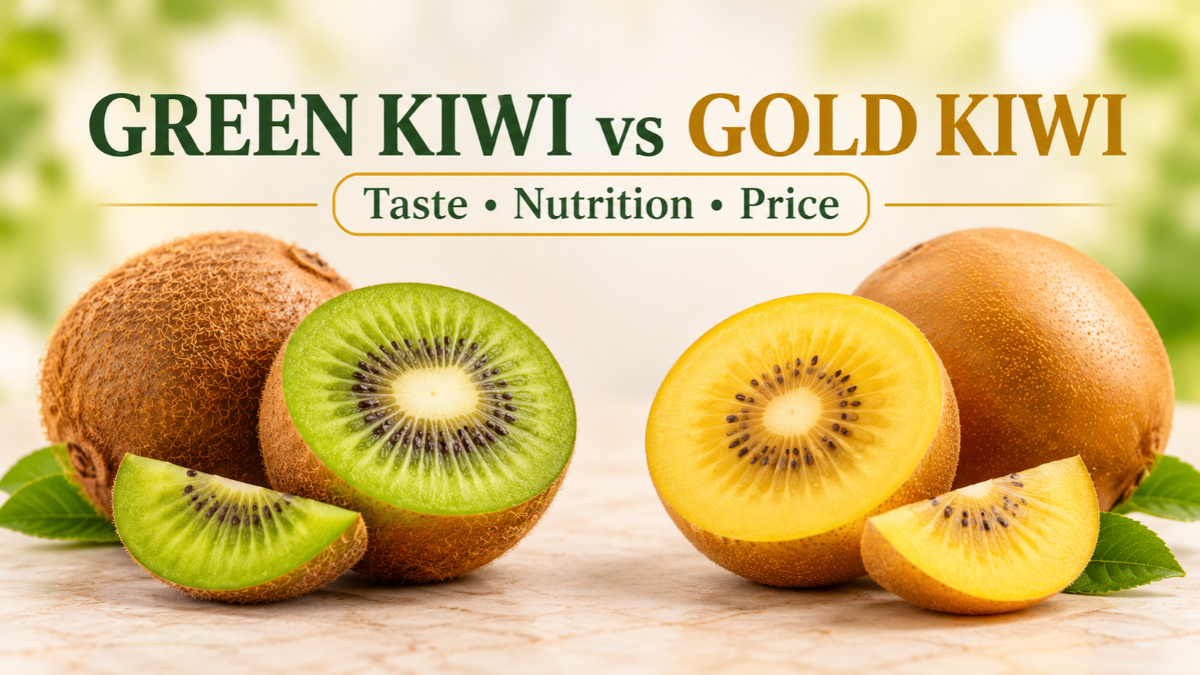
Green kiwi is the tangy one, with fuzzy brown skin and bright green flesh. Gold kiwi is sweeter, with smooth skin and yellow flesh. Gold has almost twice the vitamin C, green has about twice the fibre, and gold usually costs more.
That is the short version of green kiwi vs gold kiwi. The rest of this guide covers how each one tastes, how to tell when it is ripe, where it comes from, what it costs and which one suits you. Both are in Fruitsmith's everyday fruits range, and our guide to imported fruits in India covers the wider picture of fruit that comes from abroad.
Green kiwi vs gold kiwi at a glance
|
Feature |
Green kiwi |
Gold kiwi |
|
Skin |
Brown and fuzzy |
Golden brown, smooth and hairless |
|
Flesh |
Bright green with black seeds |
Yellow, with a smaller core and fewer seeds |
|
Taste |
Tangy and sweet |
Sweet and tropical, with little tang |
|
When you buy it |
Often firm, and may need a few days to ripen |
Usually ripe and ready to eat |
|
Vitamin C |
About 85 mg per 100 g |
About 161 mg per 100 g |
|
Fibre |
About 4 g in two fruits |
About 2 g in two fruits |
|
Calories |
About 90 in two fruits |
About 110 in two fruits |
|
Price at Fruitsmith |
From ₹125 for two |
From ₹149 for two |
The gold kiwi figures are for Zespri SunGold, the gold variety from New Zealand's Zespri. Other yellow-fleshed kiwis can taste and measure differently. Prices are as listed in November 2026 and can change.
How do green and gold kiwi taste?
Green kiwi
Green kiwi is tangy and sweet at the same time. A firm one tastes sharp. A ripe one is juicy and balanced, with a fresh acidity that works well in fruit salad recipes, smoothies and on top of desserts.
Gold kiwi
Gold kiwi is sweeter, with much less tang. Zespri describes its SunGold as tropically sweet and says some people compare the taste to a cross between a mango and a strawberry (Zespri). The flesh has a smaller core and fewer seeds than green kiwi.
If you find green kiwi too sour, gold is the one to try. If you like some sharpness in your fruit, green will taste livelier.
Skin, flesh and how to eat them
Green kiwi has brown, fuzzy skin. Gold kiwi has smooth, hairless skin in a golden brown shade. Inside, green kiwi is bright green with a ring of black seeds, and gold kiwi is yellow.
The simplest way to eat either is to cut it in half and scoop out the flesh with a teaspoon. For fruit plates, peel and slice. The skin of both is edible once washed, according to Zespri, and the smooth skin of gold kiwi is the easier one to eat.
Nutrition: how green and gold kiwi differ
Both give you vitamin C and fibre. The amounts differ.
- Vitamin C. A laboratory analysis of Zespri fruit found 161 mg of vitamin C per 100 g of flesh in SunGold, against about 85 mg commonly found in green Hayward kiwi (Food Chemistry, 2018).
- Fibre. Green kiwi has more. Zespri gives about 4 g for a serving of two green kiwis and about 2 g for two SunGold.
- Folate. Zespri lists green kiwi as a good source of folate and does not say the same of SunGold.
- Calories. Two green kiwis have about 90 calories, and two SunGold about 110, by Zespri's figures.
These numbers come from Zespri and from a study of Zespri fruit, so treat them as a guide for kiwi in general. For what these nutrients do for you, see our post on the health benefits of kiwi fruit.
How to tell when a kiwi is ripe and how to store it
Hold the kiwi in your palm and press gently. A ripe one gives slightly, the way a ripe peach does.
- Green kiwi is often sold firm. Leave it at room temperature for a few days to soften. To speed it up, put it in a paper bag with a banana or an apple.
- Gold kiwi is usually ready to eat when you buy it, and it gets sweeter as it softens. Do not leave it out for long.
Once ripe, kiwi keeps best in the fridge, away from other fruit so that it does not over-ripen. Plan to eat green kiwi within about a week. Gold keeps a little longer. Cut kiwi belongs in a closed container in the fridge and is best eaten within a day or two. Our guide on how to store fresh fruits at home covers other fruit.
Where kiwi comes from and when it is in season
Indian orchards grow green kiwi, mostly the Hayward variety. Arunachal Pradesh produces more than half of the country's crop, with Himachal Pradesh, Uttarakhand and other north-eastern hill states also growing it. The harvest runs from about September to November, depending on the region. In 2023-24, India imported more than twice as much kiwi as it grew, mainly from Chile and New Zealand (FreshPlaza).
Gold kiwi sold in India is typically imported. SunGold is Zespri's own variety, grown in New Zealand and by its licensed growers in countries such as Italy. Zespri says its New Zealand fruit is available from May to October, with fruit from Italy following from November to January. In practice, imported kiwi of one kind or another is on sale for most of the year, and Indian green kiwi reaches the market from about October to December.
Price: Is gold kiwi worth the extra?
At Fruitsmith, both come from Zespri and are sold in packs of two. Prices in November 2026:
|
Pack of two |
Green kiwi |
Gold kiwi |
|
Medium |
₹125 |
₹149 |
|
Jumbo |
₹175 |
₹249 |
Gold costs ₹24 more at medium size and ₹74 more at jumbo. Prices move with season and supply, so check the product pages for medium green kiwi, jumbo green kiwi, medium gold kiwi and jumbo gold kiwi.
Whether gold is worth it comes down to taste. If someone at home finds green kiwi too sharp, the sweeter fruit is the one that gets eaten. If you enjoy the tang, green gives you more fibre for less money.
Which should you buy?
Pick green kiwi if:
- You like tangy fruit
- You want more fibre
- You are making fruit salad, smoothies or fruit chaat, where a little sharpness helps
- You want the lower price
Pick gold kiwi if:
- You prefer sweet fruit with little tang
- You want more vitamin C per fruit
- You want to eat it the day it arrives
- You are buying for someone who has never liked green kiwi
For a fruit platter, use both. The green and yellow slices look good side by side. The same idea works for gifts: Fruitsmith's Jason fruit tray includes both green and gold kiwi, and most of the other fresh fruit boxes and trays include one or the other. If you want kiwi that keeps in the cupboard, there is also a box of sun-dried kiwi.
Frequently asked questions
1. Is gold kiwi sweeter than green kiwi?
Yes. Gold kiwi is sweet with little tang, and green kiwi is tangy and sweet. A fully ripe green kiwi is sweeter than a firm one, but it keeps its sharp edge.
2. Which has more vitamin C, green or gold kiwi?
Gold. Zespri SunGold has about 161 mg of vitamin C per 100 g, against about 85 mg in green Hayward kiwi. Green kiwi has more fibre.
3. Can you eat kiwi skin?
Yes. Zespri says the skin of both green and gold kiwi can be eaten once the fruit is washed. Gold skin is smooth and hairless. Green skin is fuzzy, which is why most people scoop out the flesh instead.
4. Is yellow kiwi the same as gold kiwi?
Shops use both names for kiwi with yellow flesh. SunGold is Zespri's variety. Zespri notes that other yellow kiwis are different varieties, which tend to be fuzzier and tangier.
5. Is kiwi grown in India?
Yes. India grows green kiwi in its hill states, led by Arunachal Pradesh, and the fruit reaches the market from about October to December. Most kiwi sold in India is still imported.
Want to taste the difference? Order a pack of each from Fruitsmith's everyday fruits, delivered in Delhi NCR within 24 hours of your order on working days. If you are choosing between other fruits, our guide to the types of apples in India follows the same format.